Release Management By Saikiran Alagatham
Software Configuration ManagementRelease Management
Release Management is a technical skill which has to be acquired by learning and practising. It is further classified as a management skill, or one of the electives of management. Release management skills equip the Release managers with necessary management skills for implementing and managing release processes for code through development, test and production. This is often referred as Release Management lifecycle.
The release Management lifecycle starts when the release manager receives a request for change or a new features. During this entire lifecycle, managers are responsible for scheduling, coordinating and management of releases across the enterprise for multiple applications across various portfolios, there will be multiple stakeholder, multiple tasks, multiple milestones, and all these entities can be managed by the Release manager using proper management tools and management skills. Skills for effective management of a project releases(PMI, 2019) are:
It can be said that Release management is a parent skill, with multiple child skills.
Conventionally, there are no defined pre-requisites for Release management as a skill, and there are no mandates related to release management, which the release manager should have. However, in order to gain expertise in release management, a person should be well versed with the domain. As a major pre-requisite he/she should have a complete understanding the software development lifecycle (SDLC) (Boyde, 2014). This is will help him/her to understand the project phases and will be helpful in planning and integrating the different project phases. Ideally, he/she should have executed software development project as team member or might have managed a project as iteration manager or project manager.
Having these pre-requisites will definitely help to manage a software engineering project as a whole. Another key prerequisite will be knowledge of ITIL processes (Thakur, 2018). This involves change management process, incident management process and problem management process. These processes are often used in different phases of the project. For example, integrating a application module into a live environment will require the release manager to schedule a change, and then perform the integration. If the integration fails, then he might have to look into problem management. So, without proper knowledge of ITIL processes these activities will be difficult to implement.
In case of software engineering, Release management is a glue that holds all the key aspects of SDLC together, including business and functional requirements. There quite a number of reasons on why release management skills are essential, or why a dedicated release manager is required to manage the project releases (Ahmed, 2016). Some of the key reasons are:
Release Management applies to various industries, in software engineering a software release manager and program manager looks after release management. A Release manager is first and foremost a project manager who looks after the software from conception to deployment.
Release management follows a wee defined path, it usually begins at the first stage of development cycle when there is a request for a change or a new feature. Once the request is approved the release manager along with the team design the new release and planning begins. The developers build the release, testing takes place and modifications may be done based on the test results. Once the release is accepted by the manager, it moves into deployment and made available for the end users.
The following picture depicts the entire process:
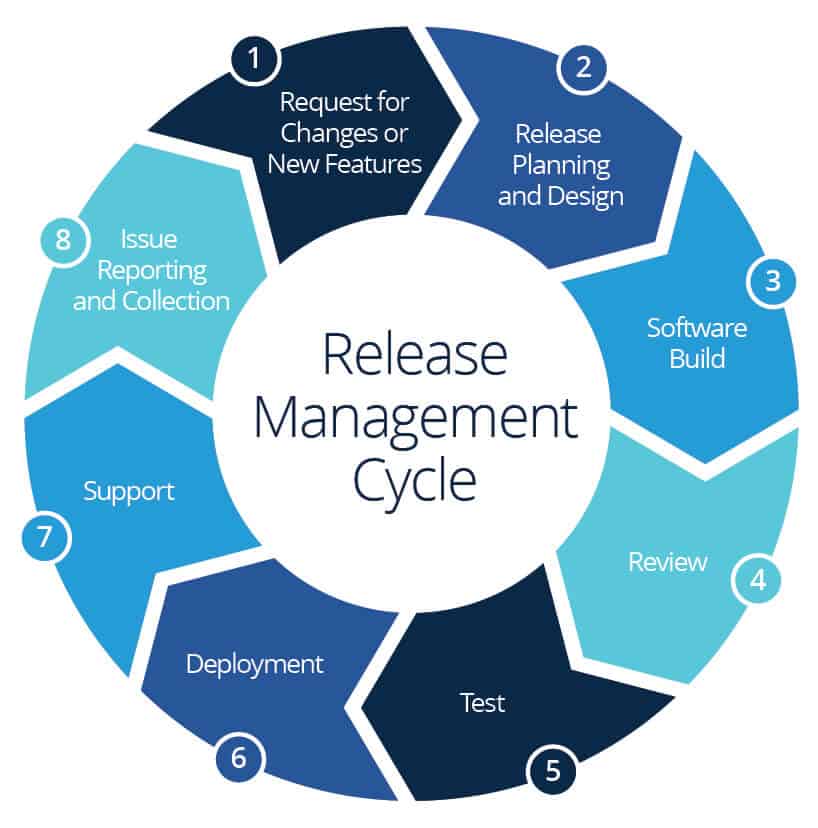
The release manager needs to be well aware of all the phases of software development lifecycle. They need know the impact of a change, how this change affects the requirements, schedule, functional specs, development and deployment of the release. A Release Manager must focus on automation of tasks, they have to build processes, methods, tools and reports that help them to make decisions whether to release a version of software or not, rather than relying on stakeholders for every decision.
A Release Manager has to have knowledge on the following tools:
As most of the software moved into Software as a Service (SaaS) model, the release management has become a vigorous process. Especially in the case of business which have far more changes and feature request that has continuous delivery pipelines.
In order speed up the delivery process, release managers use release management tools like JIRA which are used create new versions of the software by reusing the already existing versions and by automating the routine operations which are done in each release. The following short video represent how the release managers actually plans a each release :
Research papers and academic books nurture the idea of elicitation. Currently, there is a focus on the types of interviews being done, and whether they are structured interviews or unstructured, to check which collects more information compared to the other. Different research papers are conducting surveys and evaluating some techniques for eliciting requirements of computer-based systems, paying particular attention to how they deal with social issues.
There are various tools that are available in the market for release management. Some of the most popular tools are:
I would rate myself as 6 on this skill. I am a team player, and I often look to take up the responsibilities. On the other hand, I manage to finish my tasks and assignments in time, and that is why I feel I am good at time management. However, I am still exploring SDLC, and I lack experience in implementing a software project, which is a definite drawback in this case. I also lack exposure to the project management tools which is again a challenge for me. To summarise, I have leadership qualities and interpersonal skills, but I lack exposure to a real world SDLC and the release management tools, which justifies the rating I have given to myself.
-
Please find below the list of references used in writing this web page:
- Boyde, J., 2014. A Down-To-Earth Guide To SDLC Project Management (2nd Edition). New York: Springer.
- PMI, 2019. A Guide to the Project Management Body of Knowledge. Chicago: s.n.
- PMI, 2019.Software Release Management.
- Thakur, A., 2018. The ITIL® v3 - Basics: Get to know a Successful Project Manager. New Delhi: Springer.
- Ahmed, A., 2016. Software Project Management: A Process-Driven Approach. Chicago: CRC Press.
- Axelos, ITIL certifications in release, control and validation
- Plutora , Release Management ‘ https://www.plutora.com/blog/release-manager-job’
- CM crossroads, What is Release Management and why we need it ‘https://www.cmcrossroads.com/article/what-release-management-and-why-it-needed’
Page Content
